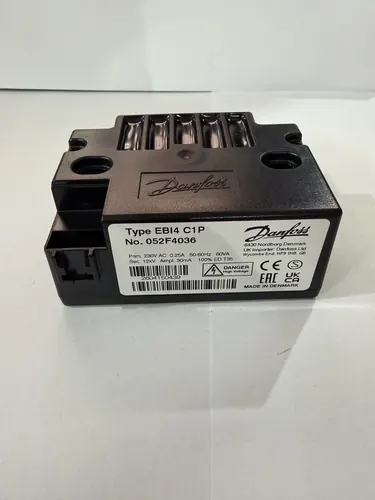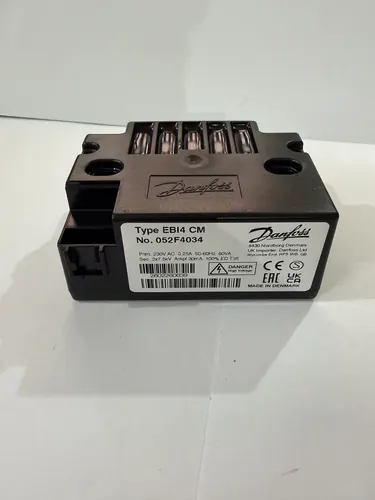
Product overview
Details that help confirm the fit.
The Danfoss EBI4 CM is a compact, high-frequency electronic ignition transformer designed for oil burners requiring continuous ignition.
The unit provides two-pole ignition through two high-voltage outputs, each rated at 7.5 kV peak. The secondary midpoint is connected to protective earth or the burner frame, allowing a stable ignition spark to be generated between two correctly positioned ignition electrodes.
The EBI4 CM operates from a 230 V AC, 50/60 Hz electrical supply and accepts an operating-voltage range of 187 to 255 V AC. High-frequency electronic operation provides efficient ignition performance while maintaining compact dimensions and low weight.
The transformer supports continuous operation with a 100% duty cycle at an ambient temperature of 35°C. At an ambient temperature of 60°C, the permitted duty cycle is 70%.
The primary connection is provided through a three-core cable, which also supplies the protective-earth connection. Two 4 mm high-voltage secondary outlets are provided for connection to the oil burner’s ignition electrodes.
Depending on the complete Danfoss product code and housing version, the secondary ignition cables may connect from the top or front of the transformer. Standard and special housing versions are available.
The EBI4 CM has an IP40 enclosure rating and is designed for ambient operating temperatures from -10 to +60°C. Danfoss recommends an ignition-electrode gap between 2.5 and 5 mm, subject to the oil burner manufacturer’s specifications.
Typical applications include pressure-jet oil burners, heating boilers, hot-water boilers, steam boilers, oil-fired furnaces, industrial ovens, hot-air generators and thermic-fluid heating systems requiring continuous ignition.
Before replacement, the complete Danfoss product code, housing style, primary connector, cable length, secondary outlet orientation, supply voltage and electrode arrangement must be verified. Installation, protective earthing, electrode adjustment and commissioning must be performed by qualified burner-service personnel.
Model, voltage, rotation, pressure range and mounting can vary. Final compatibility is confirmed against the nameplate or existing component.